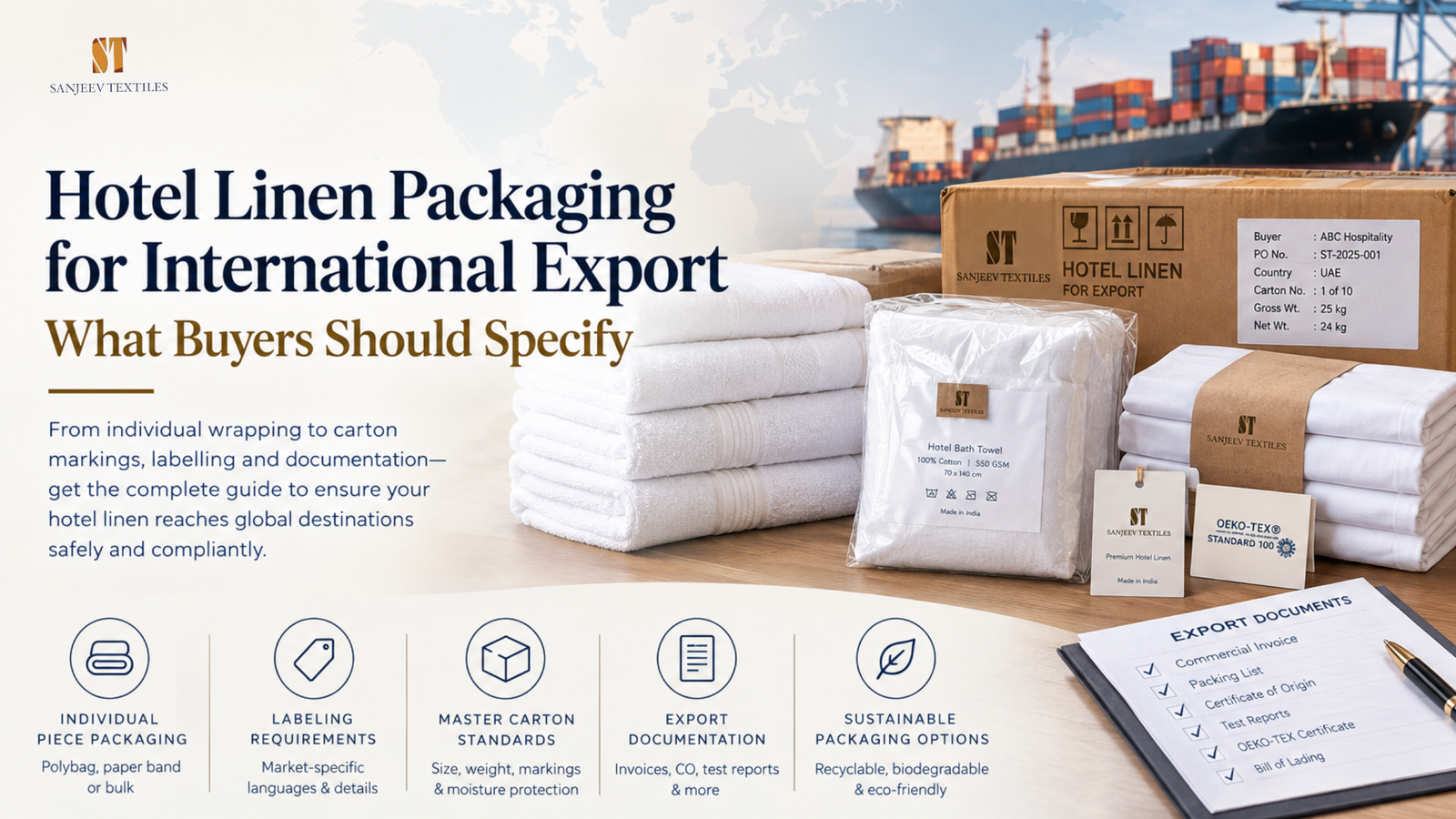
Hotel Linen Packaging for International Export: What Buyers Should Specify
Most buyers spend weeks choosing the right linen. They compare thread counts. They test fabric samples. They approve every specification carefully.
However, they almost never discuss packaging.
Then the shipment arrives. Cartons are crushed. Labels are in the wrong language. Pieces from different sizes are mixed together. Suddenly, packaging becomes the most urgent problem in the building.
This happens more often than you might think. In many export orders, packaging creates just as many mistakes as the product itself. Moreover, poor packaging causes serious delays even when the linen inside is perfectly made.
Therefore, packaging is not a last-minute decision. It is part of the order specification. Treat it that way from the start.
At Sanjeev Textiles, we have exported hotel linen to the UAE, Saudi Arabia, UK, and Europe since 2004. Furthermore, we have seen every packaging mistake that exists. So in this guide, we share exactly what to specify before your next shipment leaves our factory.
Why Packaging Affects Your Entire Operation
First, think about what packaging actually does in an export context.
It protects linen during a sea freight journey. That journey can take 20 to 28 days. Furthermore, it keeps every piece identifiable through customs, port handling, and warehouse distribution. In addition, correct labels signal to customs authorities that the shipment is properly documented.
Good packaging also reduces confusion at the receiving end. For example, a housekeeping manager who gets unlabelled cartons wastes hours sorting pieces. However, a well-marked shipment moves from the loading dock to the linen room quickly.
Consequently, packaging affects your property from the moment a shipment lands. Therefore, always specify it clearly before production starts, not after.
Specification 1: Individual Piece Packaging
The first decision is how each individual piece gets wrapped. For international export, there are three main options.
Option 1: Polybag with header card
Each piece goes into a polybag with a printed card. The card shows the product name, size, GSM or thread count, fibre content, and care instructions. This option works well for presentation. However, it uses more plastic. As a result, it creates regulatory problems in some markets.
Option 2: Folded and paper-banded
Each piece is folded neatly and held with a paper band. This option is better for bulk hotel orders. Moreover, it reduces plastic waste significantly. Furthermore, housekeeping teams find it easier to handle during room preparation. Therefore, most international hotel buyers now prefer this option.
Option 3: Loose bulk packing
Pieces are folded and packed loose into cartons without individual wrapping. This is the most cost-effective option. However, it requires a very accurate packing list. Otherwise, identifying individual pieces at the receiving end becomes difficult.
For buyers in UK and European markets specifically, Option 2 is now the right choice. Hotels in these markets can no longer use non-recyclable plastic wrapping without regulatory risk. Therefore, recyclable paper or compostable packaging should be the default for all UK and EU-bound shipments.
At Sanjeev Textiles, we offer all three options. Moreover, we help every buyer choose the right one based on their destination market.
Specification 2: Labelling Requirements by Market
This is where most first-time exporters make mistakes. Different markets have different labelling rules. Moreover, getting this wrong delays customs clearance and costs money.
Here is a simple reference guide:
| Market | Label Language | What Must Appear |
| UK | English | Fibre %, care symbols, country of origin |
| UAE and Saudi Arabia | Arabic and English | Fibre %, care symbols, country of origin |
| European Union | Local destination language | Fibre %, care symbols, country of origin |
| India domestic | English and Hindi | Fibre %, care symbols, country of origin |
Furthermore, care instructions must follow ISO 3758 internationally recognised symbols. Moreover, fibre content must state exact percentages. For example, write “60% cotton, 40% polyester” never “cotton-rich blend.” In addition, “Made in India” must appear on every individual piece label for most international markets.
Many GCC countries also require Arabic labelling for fibre content and care instructions. Therefore, always confirm the language requirement for your destination before production starts.
At Sanjeev Textiles, we prepare labels in the correct language and format for every market. As a result, your shipment clears customs without language-related delays.
Specification 3: Master Carton Standards
After individual packaging, the next specification is the master carton. This is where most bulk orders succeed or fail at the receiving end.
Carton marks, label language, SKU codes, barcode positions, and shipping marks should all be confirmed before production starts. These details may seem small. However, once packing begins, corrections become time-consuming and expensive.
Specify the following in your purchase order:
Carton size and weight:
- Maximum dimensions — 60 cm × 40 cm × 40 cm
- Maximum gross weight — 25 kg per carton
- Heavier cartons risk damage during container loading
Carton marking every carton must show:
- Buyer name and destination address
- Purchase order number
- Product description and SKU code
- Quantity of pieces inside
- Gross and net weight
- Carton number out of total for example, Carton 3 of 50
Moisture protection for sea freight:
Sea voyages expose cartons to humidity for weeks. Therefore, specify a polythene inner liner inside every carton. Furthermore, add silica gel sachets to absorb moisture during transit. Cotton linen absorbs humidity very quickly. Consequently, without moisture protection, linen can develop mildew before it reaches your property.
Specification 4: Export Documentation
Good packaging is only half the work. Furthermore, the documentation that travels with the shipment is equally important and equally often incomplete.
Packaging and labelling requirements should appear in your purchase contract as a formal annex. This document becomes your reference point in any quality dispute. Therefore, never leave it as a verbal agreement.
For every international hotel linen shipment, ask for:
- Commercial invoice — product description, HS codes, quantity, value, and Incoterms
- Packing list — carton-by-carton breakdown of every piece in the shipment
- Certificate of origin — needed to claim zero duty under trade agreements like the India-UK CETA
- Test reports — GSM, thread count, shrinkage, and colorfastness from accredited labs
- OEKO-TEX certificate — for buyers who need chemical safety compliance
- Bill of lading — the shipping document from the freight forwarder
Moreover, the packing list must match the carton markings exactly. Any mismatch between the two causes delays at customs. Therefore, always check the packing list against a sample of physical cartons before you accept the shipment.
Specification 5: Sustainable Packaging in 2026
This specification is no longer optional for UK and European buyers. Moreover, premium hotel buyers across the Middle East and Asia increasingly expect it too.
The EU Single-Use Plastics Directive and the UK plastic packaging levy have changed linen packaging rules significantly. Therefore, review all packaging specifications against current market regulations before placing any order.
Sustainable linen packaging looks like this in practice:
- Recycled cardboard master cartons — FSC certified where possible
- Paper banding instead of plastic strapping for individual pieces
- Biodegradable polybags where individual wrapping is still needed
- No single-use plastic liners — use recycled paper alternatives instead
- Minimal packaging overall — less material without losing protection
Furthermore, always ask for OEKO-TEX Standard 100 certification from your supplier. For export buyers, also check BSCI for social compliance. Moreover, ask for GRS certification if your brand needs recycled material credentials.
At Sanjeev Textiles, we offer sustainable packaging options across our full export range. In addition, we provide full compliance documentation for every destination market.
The Complete Packaging Specification Checklist
Before placing your next international linen order, specify all of the following in writing:
Individual Piece Level
- Packaging type — polybag, paper-banded, or loose bulk
- Label language — English, Arabic, or local destination language
- Label content — exact fibre %, ISO care symbols, country of origin
- Sustainable packaging — recyclable or biodegradable material required
Master Carton Level
- Maximum size — 60 × 40 × 40 cm
- Maximum gross weight — 25 kg per carton
- Carton markings — buyer name, PO number, SKU, quantity, weight, carton number
- Moisture protection — polythene liner and silica gel sachets in every carton
Documentation Level
- Commercial invoice with correct HS codes
- Packing list that matches carton markings exactly
- Certificate of origin for trade agreement duty claims
- Test reports from accredited labs on request
- OEKO-TEX certificate where the destination market requires it
- Bill of lading from the freight forwarder
How Sanjeev Textiles Handles Export Packaging
We never treat packaging as an afterthought. Moreover, we include packaging specifications as part of every export order discussion from day one.
When a new buyer contacts us, we ask about their destination market, their regulations, and their receiving warehouse setup. Furthermore, we prepare labels in the correct language before production starts. As a result, buyers receive shipments that clear customs smoothly and arrive in perfect condition.
In addition, we offer branded packaging for hotels that want linen to arrive ready to use. For example, we add hotel logo stickers, custom insert cards, and branded carton labels on request. Consequently, your housekeeping team receives linen that is already sorted and identified ready for the linen room immediately.
Since 2004, we have managed export packaging for shipments to the UAE, Saudi Arabia, UK, Europe, and beyond. Therefore, we understand exactly what each market requires and we build it into your order from the very start.
Export-Ready Linen Packaged Right, Every Time
At Sanjeev Textiles, we manufacture and export premium hotel linen from Jaipur, India. Furthermore, we build the right packaging specification for every international market into every order so your linen arrives correctly, clears customs fast, and reaches your linen room ready to use.
- Visit Sanjeev Textiles
- +91 9828024121
- info@sanjeevtextiles.com
Direct manufacturer · Export-ready packaging · Market-specific labelling · Pan-India and global supply
Labels for UAE imports must include both Arabic and English. Furthermore, they must show exact fibre percentages, ISO care symbols, and country of origin. At Sanjeev Textiles, we prepare Arabic and English labels as standard for all UAE and Saudi Arabia shipments.
Specify a polythene inner liner and silica gel sachets inside every master carton. Moreover, ensure all cartons are sealed correctly before loading. At Sanjeev Textiles, we include moisture protection as standard on all sea freight export orders.
We recommend a maximum gross weight of 25 kg per carton. Furthermore, carton dimensions should not exceed 60 × 40 × 40 cm. This keeps cartons safe for port handling and reduces damage during container loading.
Not fully mandatory yet. However, the UK plastic packaging levy makes non-recyclable packaging more expensive. Moreover, most premium UK hotel buyers now specify recyclable or biodegradable packaging as a brand standard. Therefore, we recommend sustainable packaging for all UK-bound shipments.
Yes always. Every Sanjeev Textiles export shipment includes a detailed carton-by-carton packing list. Furthermore, it matches the carton markings exactly. We also provide the complete documentation package commercial invoice, certificate of origin, test reports on request, and bill of lading.
Hotel Linen for Spa & Wellness Properties: How Specifications Differ from Hotels

Hotel Linen Forecasting: How to Plan Inventory for Peak Season Demand

Related Post
What Buyers Should Know About Linen Return on Investment
- Posted September 30, 2026
- by admin
Linen Inventory Management for Hotels: A Practical Guide
- Posted September 26, 2026
- by admin
Custom Embroidery and Logo Branding on Hotel Linen
- Posted September 25, 2026
- by admin