
Hotel Linen Forecasting: How to Plan Inventory for Peak Season Demand
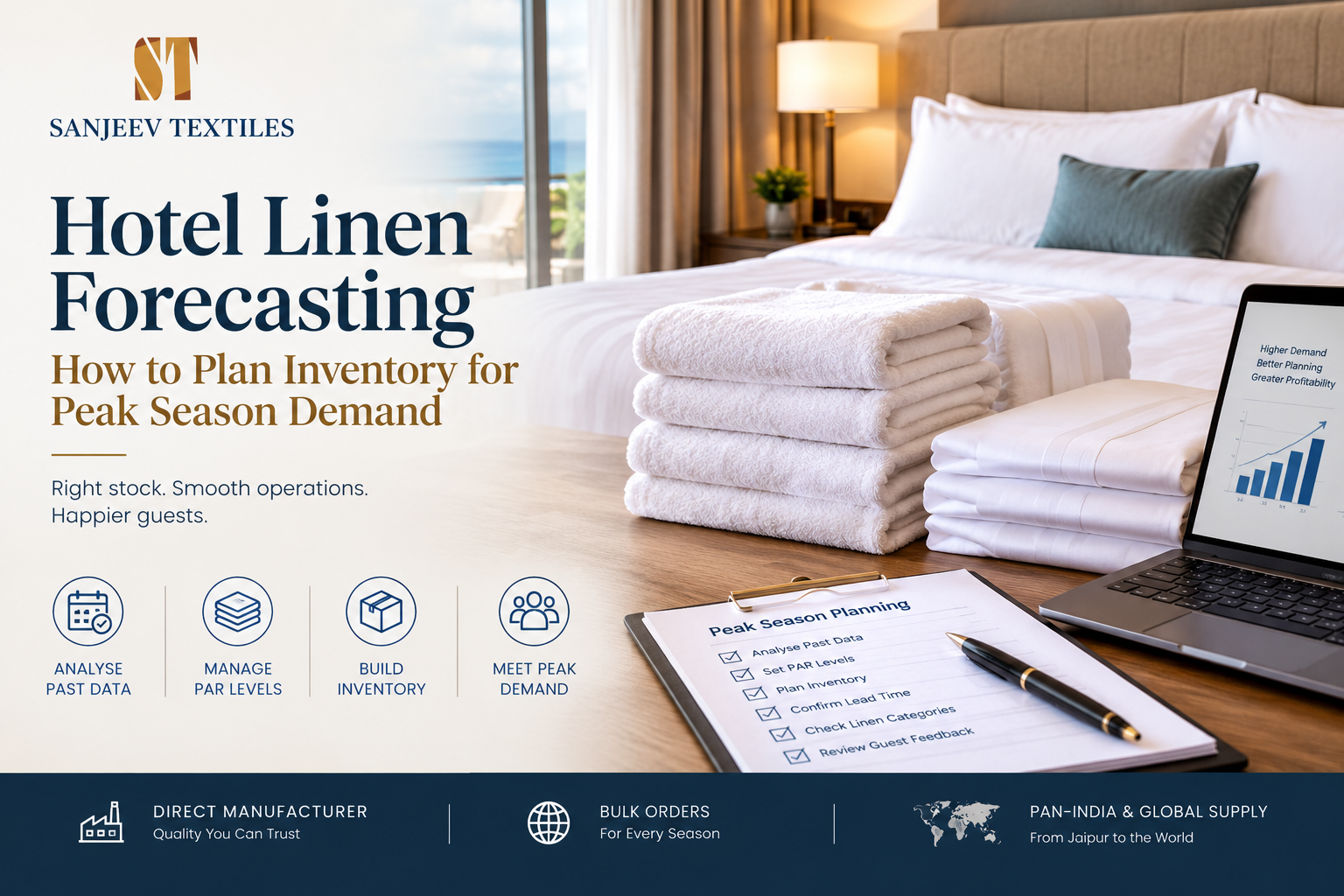
Every hotel has a peak season. For some, it is summer. For others, it is the wedding season or a busy festival period. However, the challenge is always that the same linen runs out at the worst possible moment.
Imagine this. Your front desk is flushing rooms. Housekeeping runs dry on towels. The linen room is empty. That scenario costs time, money, and guest trust. Moreover, it is completely avoidable.
Good linen forecasting is a solution to this problem BEFORE it happens. In addition, it ensures that your operations run smoothly, costs are predictable, and your guests remain happy during your h busiest weeks of the year.
Since 2004, we have sold hotel bed linen to hotels all over India, the UAE, and the UK. Hence, we know about the meaning of peak season and how to plan accordingly.
Step 1: Look at Last Year’s Data First
The best place to start is your own history. Review the occupancy data for the past 12 months. Determine the moments when you were regularly overbooked at your hotel. Recognize the times when your hotel was always full. In addition, make sure that you pay attention to events, weddings, festivals, and conferences that drive demand up as well.
When forecasting, you should take into account the patterns of usage over the years, the number of people who are expected to stay in the building, and the information you have regarding future events. In addition, sophisticated analytics allow for more accurate demand modelling. But even a simple spreadsheet will suffice with the right numbers to track.
Ask yourself these questions:
- When did linen run short last year?
- Which items ran out first: towels, bed sheets, or F&B linen?
- How many days before peak did you place your last reorder?
The answers to these questions tell you exactly where to focus your planning. Therefore, always start with data, not guesswork.
Step 2: Understand Your PAR Level
PAR stands for Periodic Automatic Replenishment. It is the minimum number of linen sets your hotel needs to run without shortages.
Industry best practices recommend 3 to 5 PAR levels for most hotels. However, during peak season, you may need to push that number even higher. Here is a simple way to think about it:
- 1 PAR: linen currently in use on beds and in bathrooms
- 1 PAR: linen in the laundry cycle
- 1 PAR: clean linen ready in the linen room
So a hotel with 100 rooms at 3 PAR needs 300 sets of every linen item in circulation. Furthermore, during peak season with 90% occupancy and faster room turnover, that number should increase to 4 or even 5 PAR.
Resort properties face particular challenges. Beach resorts may see 90% occupancy in summer but drop to 30% in the off-season. Moreover, mountain properties reverse this pattern. Therefore, your inventory should adjust for these predictable changes not stay fixed at one level year-round.
| Property Type | Off-Peak PAR | Peak Season PAR |
| City hotel | 3 | 4 |
| Beach resort | 2–3 | 4–5 |
| Mountain resort | 3–4 | 4–5 |
| Wedding venue hotel | 3 | 5 |
| Spa and wellness resort | 3 | 4–5 |
Many resorts maintain inventory levels exceeding 15,000 pool and spa towel units to support peak seasonal operations. Therefore, always calculate PAR based on your busiest expected week not your average week.
Step 3: Order Early Very Early
This is where most hotels make the biggest mistake. They wait until linen runs low before placing a reorder. However, by then it is already too late.
A typical production lead time from a manufacturer is 3 to 4 weeks. Furthermore, sea freight from India to international destinations takes 20 to 28 additional days. So if your peak season starts in June, you need to place your linen order no later than March.
Forecasting should not happen in isolation. Collaboration between laundries, linen suppliers, and hotel teams ensures alignment on anticipated volume changes. Therefore, communicate your peak dates to your supplier early. As a result, they can schedule your production run and prioritise your delivery accordingly.
At Sanjeev Textiles, we ask every hotel client about their upcoming peak season during the initial order discussion. Moreover, we help plan production timelines so linen arrives well before demand peaks, not after.
Step 4: Separate Your Linen Categories
Not all linen categories follow the same demand curve. Therefore, plan each category separately.
1. Bed linen: follows room occupancy directly. So when occupancy rises, bed sheet and pillow cover demand rises at the same rate.
2. Bath linen: is more variable. Guests use towels more frequently during hot weather. Furthermore, resorts with pools see much higher towel consumption than city hotels. In addition, spas and wellness areas create their own separate demand spike.
3. F&B linen: depends on your event calendar. For example, a wedding weekend requires far more tablecloths, napkins, and chair covers than a regular week. Therefore, always cross-check your event bookings when planning F&B linen stock.
Here is a simple peak season linen checklist by category:
Bed Linen
- Bed sheets: increase PAR by 1 above normal level
- Pillow covers: order 20% above your room count
- Duvet covers: match bed sheet PAR level
Bath Linen
- Bath towels: increase PAR to 5 during summer
- Pool towels: order based on pool capacity, not room count
- Bath robes: stock 1.5 per room during luxury peak periods
F&B Linen
- Tablecloths and overlays: align with event bookings
- Napkins: order 3× the number of covers per event
- Chair covers: match confirmed event seat count
Step 5: Use Guest Feedback as a Forecasting Tool
Sometimes the best forecasting tool is your guests themselves. Are guests mentioning worn-out towels or thin sheets in reviews? That is a live signal that your current stock is not performing well enough for peak demand.
Furthermore, when hotels review inventory data after peak periods, patterns become clear. Some rooms cycle linen faster. Certain booking types drive higher replacement rates. Therefore, use post-peak reviews to refine your next season’s forecast.
Technology also helps. AI-driven forecasting tools analyse historical data, seasonal trends, and local events to suggest optimal stock levels for each linen category. Moreover, RFID linen tracking gives real-time visibility into exactly how much stock is in use, in the laundry, and in storage. However, even without technology, a simple PAR tracking sheet reviewed weekly during peak season keeps you in control.
Why Ordering from a Direct Manufacturer Helps During Peak Season
Distributors manage fixed inventory. When demand spikes across multiple hotel clients at once, stock runs out quickly. As a result, delivery timelines extend exactly when you need speed most.
A direct manufacturer, however, produces to your order. Therefore, your peak season requirements go straight into the production schedule. Furthermore, your specifications stay on file so reorders match your approved samples exactly, every time.
At Sanjeev Textiles, we plan production runs around our clients’ seasonal calendars. Moreover, we offer priority scheduling for existing clients with confirmed peak season dates. As a result, hotels that plan early receive their linen well before the season starts, not scrambling to reorder during it.
Plan Your Peak Season Linen Before the Rush Starts
At Sanjeev Textiles, we help hotels plan linen inventory for every season with direct factory pricing, priority scheduling, and complete customisation.
- Visit Sanjeev Textiles
- +91 9828024121
- info@sanjeevtextiles.com
Direct manufacturer · Peak season planning · Bulk orders · Pan-India and global supply
Order at least 8 to 12 weeks before your peak season starts. This allows 3 to 4 weeks for production and additional time for shipping and delivery. Moreover, for international orders from India, add sea freight transit time of 20 to 28 days. Therefore, planning 3 months is always the safest approach.
Start with your standard PAR level, usually 3 for most hotels. Then increase by 1 PAR for every significant rise in expected occupancy. For example, a hotel expecting 90% occupancy during peak should plan for 4 to 5 PAR. Furthermore, always add a 10% buffer for unexpected demand spikes.
Bath towels run out first in most hotels. They are used more frequently than bed sheets and wear out faster under high-turnover conditions. Therefore, always increase bath towel PAR by at least 1 above your standard level before peak season begins.
Yes. We offer priority production scheduling for existing clients. Moreover, we keep your specifications on file so urgent reorders match your approved samples exactly. Contact us at least 6 weeks before your peak season for best results.
Not necessarily. However, you should order higher GSM bath towels and higher thread count bed sheets for peak season because guest expectations are higher and linen gets more scrutiny. Furthermore, investing in premium linen for peak periods directly improves your review scores and repeat booking rates.
Hotel Linen Packaging for International Export: What Buyers Should Specify

How to Order Custom Hotel Linen Samples Internationally

Related Post
What Buyers Should Know About Linen Return on Investment
- Posted September 30, 2026
- by admin
Linen Inventory Management for Hotels: A Practical Guide
- Posted September 26, 2026
- by admin
Custom Embroidery and Logo Branding on Hotel Linen
- Posted September 25, 2026
- by admin