Home F & B Hotel Linen Quality Control: 10 Checks Every Hospitality Buyer Should Know

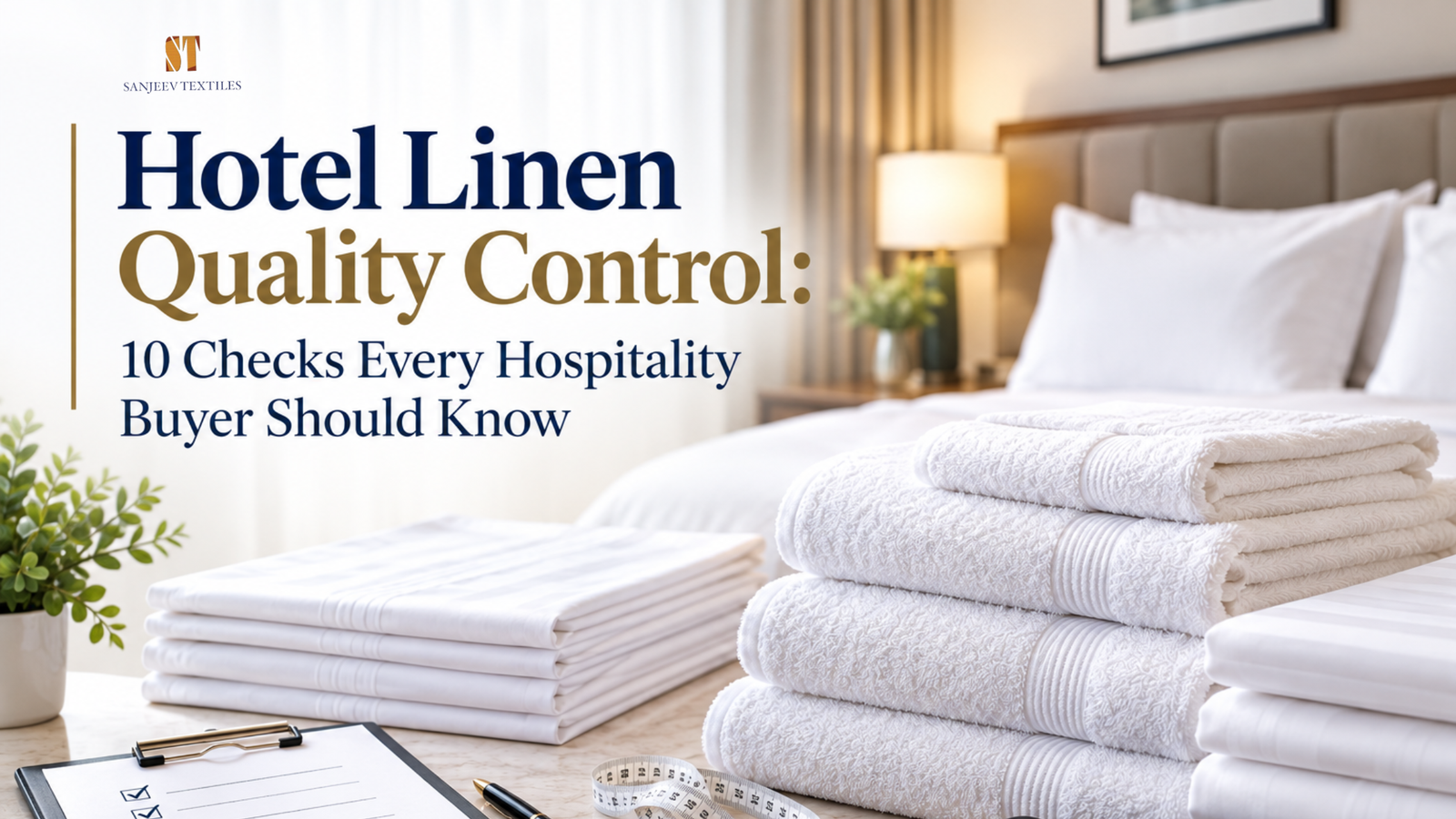
Hotel Linen Quality Control: 10 Checks Every Hospitality Buyer Should Know
Hotel Linen Quality Control

Most hotel linen issues don’t begin at the laundry. They begin at the buying end.

Buyer accepts a sample. Fabric has a nice feel to it. The colour appears bright. It has a competitive price. The order is taken, the delivery comes in, and three months later the sheets are grey, the towels are thin, and the tablecloths don’t drop to the table.

In the hotel industry, linen is treated as a rotating asset, not just decor, so quality is judged differently. You aren’t purchasing just for a single purpose. You are purchasing fabric that will be subjected to commercial laundry, housekeeping, and the demands of a paying guest.

Since 2004, Sanjeev Textiles has been producing hotel linen. We’ve experienced all the quality failure patterns, and we perform all of these tests before a single product leaves our factory. In plain English, right here for all hospitality buyers to use now. 

1. Verify Thread Count Is Single-Ply

The most mentioned and manipulated quality number for bed linens is thread count.

Many suppliers intertwine two yarns and count them as two, but the quality of the fabric remains the same or decreases. In most applications in hospitality, single-ply at 300TC is better than multi-ply at 600TC.

Always ask for a product specification sheet, including single- or multi-ply. If you are ordering in bulk, request a third-party lab test report. If the supplier hesitates, you’ll know right away. 

2. Weigh the Towels Before Accepting

For bath linen, GSM grams per square metre determines absorbency, weight, and durability. A towel labelled 600 GSM that actually weighs 480 GSM is more common than most buyers realise. Nobody checks. The delivery is accepted. Six months later, guests noticed.

Quick GSM guide:

GSMBest For
300–400Budget and high-turnover hotels
400–5503-star and 4-star properties
550–7004-star and 5-star hotels
700–850Luxury hotels, spas, resorts

Weigh a sample towel on a digital scale and calculate GSM against its measured dimensions. This takes five minutes and saves months of complaints.

3. Demand Exact Fibre Composition

The raw material determines durability, softness, and laundering lifespan arguably more than thread count. A red flag is suppliers listing “cotton-rich” without specifying percentages.

Cotton-rich could mean 55% cotton or 80% cotton. Without the exact number, you have no quality benchmark and no basis for a complaint. Require the exact fibre percentage on every product specification. For UK and European buyers, this must also appear on the fabric label by law.

4. Always Do a Shrinkage Wash

Commercial sheets must survive at least 200 industrial wash cycles. Retail sheets degrade very quickly under the extreme heat and harsh chemicals of industrial washers.

A bed sheet that fits perfectly on day one may come up two inches short after five washes. The industry standard is a maximum 3% shrinkage for bed linen and 5% for towels after five wash cycles at 60°C.

Before accepting bulk delivery, wash three sample pieces at your hotel’s standard laundry temperature. Measure before and after. If shrinkage exceeds the standard, reject the batch.

5. Test That White Stays White

Graying and yellowing are the most visible signs of poor colour fastness, and guests notice immediately. Many suppliers use optical brightening agents to make linen appear white. These wash out over time, causing yellowing.

Wash sample pieces 10 times at your standard laundry temperature. Compare whiteness against the original. For coloured F&B linen, run the piece through a wash alongside a white cloth; check for any dye bleed or colour transfer.

6. Pull Every Seam

Stitching failure is the silent killer of hotel linen. A loose hem looks fine in the linen room and unravels after 20 washes. Hem stitching should be tight, even, and reinforced at corners.

Run your finger firmly along every seam. Pull gently at the corners. Check for:

  • Minimum 12 stitches per inch along all seams
  • Consistent hem width, no variation greater than 2mm
  • Mitered corners on bed sheets not folded over
  • No loose threads anywhere on the piece
  • Towel borders straight and consistent in width

If anything gives, the stitching is not hotel-grade.

7. Measure Everything

Size errors in bulk orders create real operational chaos. A fitted sheet 5cm shorter than specified will not stay on the mattress. A tablecloth 10cm narrower than ordered will not achieve the correct drop.

Acceptable size tolerances:

ProductTolerance
Bed sheets±1.5 cm length and width
Pillow covers±1 cm all dimensions
Bath towels±1 cm length and width
Table overlays±1.5 cm all dimensions
Chair covers±0.5 cm — fit is critical

Measure five random pieces from different carton positions, not just the top layer. Always measure after washing one sample piece too, because shrinkage affects fit.

8. Request Tensile Strength Reports

Common quality control tests for hotel linens include tensile strength, tear resistance, shrinkage, Martindale abrasion, and pH testing.

Tensile strength determines how long linen survives the mechanical stress of commercial laundering. A fabric that looks and feels fine may still tear at seams after 30 washes if tensile strength is weak. A textile buying specification cited by hotel-linen buyers says table linen tensile strength should be at least 70 kg per 5 cm in both warp and weft.

Ask your supplier for a tensile strength test report from SGS, Bureau Veritas, or Intertek. A reliable manufacturer provides this without hesitation.

9. Check pH and Safety Certification

This one surprises most buyers, but it should not.

A sheet can look perfectly white but still be very dirty. Microbiological testing verifies the complete absence of harmful pathogens like Staph and E. coli.

Beyond microbiology, the pH level of finished fabric must be between 4.5 and 7.5 to be skin-safe. Fabric outside this range irritates, a serious issue for guests with sensitive skin.

A reliable supplier should provide documentation of compliance with standards such as ISO 9001 for quality management systems or other relevant certifications. At Sanjeev Textiles, we offer OEKO-TEX Standard 100 certified options, testing over 100 harmful substances across our full range.

10. Open Every Carton, Not Just the Top One

The oldest trick in bulk supply is putting the best pieces at the top of the carton and filling the rest with substandard stock. If final inspection is weak, the buyer may receive correct products in the wrong grouping, old barcode versions, or mixed packing logic inside the same shipment.

Before signing any delivery note:

  • Open a minimum of three cartons from different pallet positions
  • Pull pieces from the bottom and compare against the approved sample
  • Check colour consistency across pieces side by side
  • Verify product labels match specification fibre content, care instructions, and country of origin
  • Count pieces against the packing list; shortages are common and easy to miss

Conclusion

The best linen is often the one that holds its shape, resists weak points, and stays presentable after many commercial cycles, even if it feels less luxurious in the hand on the first day.

Price per unit is the wrong metric. Cost per wash cycle is the right one.

At Sanjeev Textiles, we run all 10 of these checks on every batch before it leaves our Jaipur factory. Thread count verification. GSM weighing. Shrinkage wash tests. Tensile strength reports. Batch consistency checks across every carton. Quality control at every production stage, not just at the end.

We have supplied hotel linen since 2004. We know what fails, when it fails, and why. And we manufacture so it does not.

10 QC Checks — Quick Reference

#CheckRed Flag
1Thread Count — single-ply confirmed600TC+ at very low price
2GSM — matches label on scaleLabelled GSM heavier than actual
3Fibre Composition — exact % stated“Cotton-rich” — no % given
4Shrinkage — max 3% after 5 washesNo wash test data
5Whiteness — stays white after 10 washesGraying or yellowing early
6Stitching — 12 stitches/inch minimumLoose threads, uneven hems
7Size — within ±1.5cm toleranceNo measurement verification
8Tensile Strength — lab report availableNo test documentation
9pH & Safety — 4.5–7.5, OEKO-TEXNo certifications offered
10Batch Consistency — all cartons checkedOnly top carton inspected

Work With a Manufacturer Who Checks What You Cannot

At Sanjeev Textiles, quality is built into every production stage, not added at the end.

Direct manufacturer · OEKO-TEX options · Third-party test reports · Pan-India & global supply

How many wash cycles should hotel linen survive?

Hotel-grade linen must survive a minimum of 200 commercial wash cycles. At Sanjeev Textiles, we test our linen to withstand 200 to 300 cycles and provide wash test reports before delivery.

What is the most important quality check for hotel towels?

GSM. Weigh a sample towel and calculate actual GSM against its dimensions before accepting any bulk delivery.

What does OEKO-TEX certification mean for buyers?

It certifies the fabric has been tested for over 100 harmful substances, including residual chemicals, pH, and colour fastness. We offer OEKO-TEX certified options at Sanjeev Textiles.

Should we always ask for third-party lab reports?

Yes always. For thread count, tensile strength, shrinkage, and GSM. A manufacturer who hesitates on this is a manufacturer worth reconsidering.

Can we visit the Sanjeev Textiles factory before ordering?

Absolutely. We welcome factory visits, third-party audits, and pre-production sample approvals at our Jaipur facility anytime.

Related Post

Leave a Reply

Your email address will not be published. Required fields are marked *