Custom Hotel Linen: From Design Approval to Bulk Production
- admin
- August 29, 2026
- Room Linen
Every hotelier knows that linen is more than fabric on a bed or a table. It is the first thing a guest touches when they collapse onto a mattress after a long journey, and the last thing they remember when they check out. For hotel brands looking to stand apart, custom linen — with signature thread counts, monograms, colour palettes, and finishes — has become a quiet but powerful part of brand identity. But turning a design concept into thousands of consistent, durable pieces across a hotel chain is a process with many moving parts.
At Sanjeev Textiles, we’ve guided hotel chains and boutique properties alike through this exact journey. Here’s how custom hotel linen actually moves from an approved design to a finished bulk order.
Step 1: Understanding the Brief
The process always starts with a conversation, not a sketch. A hotel’s procurement or design team typically arrives with a vision: perhaps a boutique property wants heavier, textured waffle-weave bathrobes, or a five-star chain wants crisp 300-thread-count sateen sheets with a subtle woven monogram. At this stage, the manufacturer needs to understand more than aesthetics — occupancy levels, laundry frequency, local water hardness, and guest demographics all influence which fabric will actually perform well in daily use. A linen that looks stunning in a showroom but pills after ten industrial washes is not a design win; it’s a costly mistake.
Step 2: Fabric and Yarn Selection
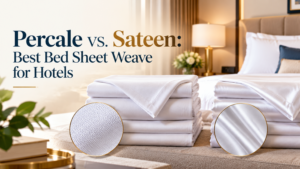
Once the brief is clear, the real technical work begins with yarn and fabric selection. Cotton quality is graded by staple length — long-staple and extra-long-staple cottons (like Giza or Supima) produce smoother, stronger yarns that resist pilling and hold their whiteness through repeated commercial laundering. Blended fabrics, such as cotton-polyester mixes, are often chosen for high-turnover properties because they resist wrinkling and dry faster, reducing laundry turnaround time. The weave also matters: percale offers a crisp, cool hand-feel ideal for warmer climates, while sateen delivers a silkier, slightly warmer drape that many luxury properties prefer.
You can browse Sanjeev Textiles’ range of hotel bed linen and bath linen collections to see how these fabric and weave choices translate into finished product lines.
Step 3: Sampling and Design Approval
This is where the design truly comes to life. A small batch — usually just a handful of pieces — is produced to the exact specifications discussed in the brief. This includes not just the base fabric, but any customization: embroidered logos, jacquard borders, piped edges, or tonal stitching. Colour matching is done against precise Pantone references, since hotel brand guidelines often specify an exact shade for duvet covers, curtains, or cushion covers, and even slight variance can look inconsistent across a property.
Samples are shipped to the client for physical inspection — colour under different lighting, feel against skin, weight, and stitching quality all get evaluated. It’s common for two or three rounds of sampling to happen before final sign-off, particularly for logo embroidery, where thread density and placement need fine adjustment. This iterative back-and-forth might feel slow, but it is the single most important phase for preventing expensive errors later. A flaw caught in a sample of five costs a few metres of fabric; the same flaw caught after producing five thousand pieces can be devastating.
Our custom and private-label linen manufacturing service is built around exactly this kind of iterative sampling, so hotel brands sign off only once every detail is right.
Step 4: Costing and Order Finalization
Now that the design is approved, it’s time for commercials. Bulk pricing will vary based on fabric quality, quantity, design, and time to delivery. Reputable manufacturers will be able to give you a breakdown of the costs involved, including the raw materials, weaving or knitting, dyeing, stitching, embroidery, and packaging, so hotel buyers can make informed decisions, such as selecting a slightly lower thread count to keep their budget in check or a higher level of embroidery to add to the fabric.
Also at this point, delivery plans are fixed, especially for hotels opening on a certain date or stocking up on linens ahead of the peak season. Large linen chains will have staggered delivery schedules, so that linen can be received property by property instead of a single huge delivery.
Step 5: Raw Material Procurement and Dyeing
When the order is confirmed, raw yarn or greige fabric is immediately ordered at scale. If things are big orders, uniformity between dye lots becomes a major quality control measure — a white sheet dyed in two different batches may have a slight color difference, but in hundreds of sheets, it will be noticeable. A good mill would batch-dye in regulated lots and use a spectrophotometer to check colour uniformity, not the human eye.
Step 6: Cutting, Stitching, and Embroidery
Once the fabric is prepared, it is then cut and seamed. Automated cutting tables guarantee uniformity of panel size with thousands of pieces; a slight difference in a pillowcase seam is a minor issue, but multiplied by thousands of pieces in an order, results in noticeably mismatched pillowcases on guest beds. Embroidery (when needed) is typically performed on a multi-head embroidery machine with a computer that makes an exact copy of the approved sample on each individual piece with the same stitch count and thread tension.
There are generally three checkpoints for quality control: after cutting, after stitching, and before packing. Tolerance is checked by skilled inspectors at the seams, hems, and embroidery placement, and any that does not adhere to the tolerance is separated out and not shipped. This is part of our quality assurance process at Sanjeev Textiles, and every bulk order undergoes this multi-stage inspection before being sent out.
Step 7: Finishing, Pressing, and Packing
Linens are finished before packing, pressed, folded, and by some hotels treated with anti-microbial and/or stain-resistant chemicals. Often folding standards are also customized, with brands of hotels having a “signature” fold for towels or a specific packaging style for in-room welcome sets. Packaging comes in no way as a by-product: linens are usually wrapped in moisture-proof material to ensure their safe transport and storage en route and are identified by size, colour, and quantity on the card for ease of hotel-end receiving and distribution.
Step 8: Bulk Production and Dispatch
With sampling, dyeing, stitching, and quality control processes validated, the manufacturer moves into full bulk production. Because the entire specification was locked down during the sampling phase, this stage is largely about scaling up proven processes rather than problem-solving on the fly. Dispatch is coordinated according to the agreed delivery schedule, often with documentation support for customs clearance on international orders.
Why the Process Matters
The distance between a beautiful design concept and a warehouse full of consistent, durable, guest-ready linen is significant — and it’s bridged by careful sampling, disciplined quality control, and manufacturing partners who understand hospitality’s unique demands. For hotels, choosing a linen manufacturer isn’t just about price per piece; it’s about finding a partner who treats each stage of this journey, from first brief to final dispatch, with the same care a guest expects when they walk into their room.
If you’re planning a new property launch or a linen refresh, get in touch with the Sanjeev Textiles team to discuss your requirements and request samples.
Timelines will depend on the volume of the order and on the complexity of the customisation; after which the time to sample and receive approval is usually a few weeks, and the time involved in production and dispatch will depend on the order volume as well as whether the orders are to be dispatched staggered between various properties.
The number of MOQs will vary according to the type of fabric, the weave, and level of customization (e.g., embroidery, jacquard work). The best thing to do is to contact the Sanjeev Textiles team to specify your property size and requirements for an accurate MOQ and quotation.
Yes. Each of these options can be added together for a single custom order, and are all checked during the sampling process before going into bulk production to ensure they are colour matched to Pantone charts, logo embroidery, and branded packaging or folding format.
Fabric is dyed in controlled batches, and the colour is checked with spectrophotometers, not merely by visual examination; this makes it difficult to distinguish any differences between dye lots even if large amounts of fabric are used.
Cotton-polyester blends are frequently used in high-traffic uses because they are less prone to wrinkling, dry more quickly and do not present as many problems as all-cotton materials in high industrial wash frequency applications; however, all-cotton materials such as cotton percale or sateen are still in use for a more premium feel and natural look.
Hotel Pillow Protectors and Mattress Protectors: Why They Matter
Related Post
Hotel Pillow Protectors and Mattress Protectors: Why They Matter
- Posted August 29, 2026
- by admin
Hotel Bed Sheet Supplier India for UK Hotels — Bulk Orders & Direct Pricing
- Posted July 27, 2026
- by admin
Microfibre Pillow Manufacturer in India: What to Look For
- Posted June 19, 2026
- by admin